Mark and I just spent a week with family in Estes Park, Colorado and while this post may not have a direct connection to gardening it is (in part) the reason I have been away from the garden and the blog.
My July weekends were mostly dedicated to creating a quilt for our new cousin Asher that features fabric from Erik Carl's "The Hungry Caterpiller." A special thank you to mom for hooking me up with most of the fabric!
Here is the front:
And the back:
We came back to a well maintained garden thanks to my giving everything a good soak before leaving and our dear neighbor Andrea watching out for those plants that needed watering while we were gone. More on this later on this week...
We were greeted by two ripened tomatoes, two zucchini, and two tromboncino squash upon our return - hopefully with more to come in the next couple of months!
Monday, August 29, 2011
Saturday, August 13, 2011
Catching up - Pealicious!
I have been remiss in posting lately, but promise to get back on the band wagon with the goal of posting once a week.To catch you up, here is some info on the pea experiment
Well, as it turns out I went out of town during the height of our pea harvest.
Fortunately, our neighbors helped us enjoy the bounty and there were enough for us to enjoy some too.Unfortunately we came back to many pods that were past their prime. Who knew months ago that mid-July would be prime pea harvesting time?

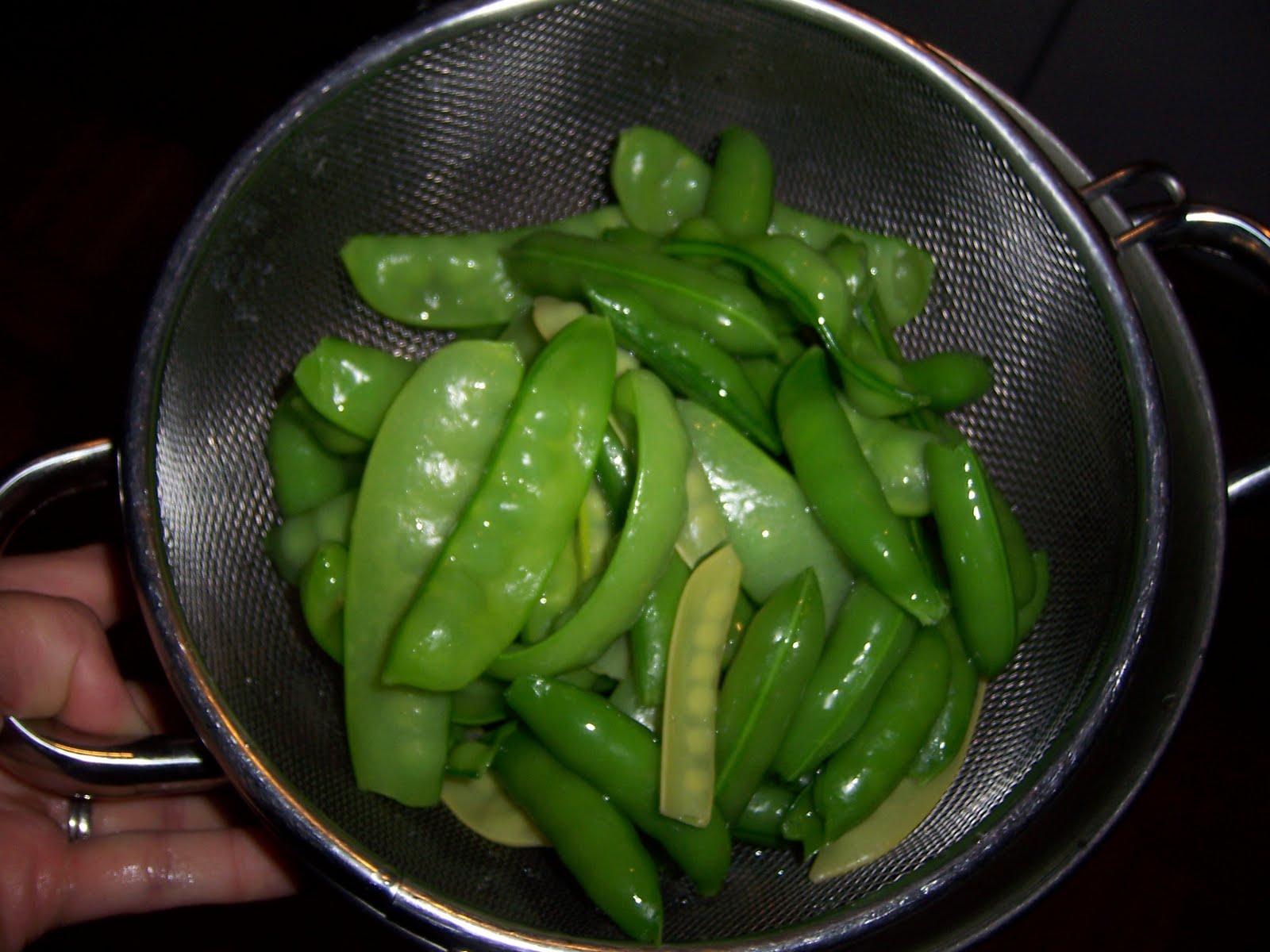
The majority of the peas that we enjoyed mid-July went into salads. We blanched the peas for both - a quick dip in boiling water to preserve their color and stop the sugars from converting to starches - and then created a dressing of minced shallot, finely chopped mint, lemon juice, olive oil, Dijon mustard and salt and pepper to taste. Yum!
I learned a few lessons about cultivating peas this year -
- Five varieties may be too many. Next year I think that we will grow fewer varieties of peas and perhaps less of them.
- As it turned out, the golden snow peas weren't as interesting to eat as I anticipated, though this could be the quality of soil where they were planted. I may try them one more time...
- I am still not quite sure how we were to use the purple soup peas, but am sure that if we grow them again it will only be for their amazing purple flowers and pods! Perhaps a pea teepee out front?
- You can't count that they will be ready when you want them to be, so watch what you plant underneath or near by to them. I had tomato starts between the rows of peas in both of the troughs with the plan that as the peas phased out in June the tomato starts would have room and the light they need to come in. With the peas lasting through mid-July they definitely stunted the tomato starts initially.
- The chicken wire trellises worked well for the peas. The thing I like best about these is that I can roll the whole thing up at the end of the season and it won't take up much room in my garage. I should note though that the purple peas were supposed to be about 6 feet but ended up far taller than that. As a result, they tumbled over the top of the trellis and cascaded nearly to the ground.
Next up ...Favas!
Tuesday, August 9, 2011
Waterwise Gardening Interview

Interested in learning more about incorporating water wise practices into your garden?
Check out the Regional Water Provider's Consortium's website www.conserveh2o.org where you can find all sorts of water conserving resources.
Sunday, July 17, 2011
Potatoes!
Last year I read about growing potatoes vertically in one of the gardening magazines I subscribe to and ever since then I have been obsessed with the idea!
While in Seattle in April, I came across a nonprofit selling used burlap sacks that were originally used by local coffee roasters to transport their beans. I bought three and two of which are now at home on our driveway with potatoes growing in them.
Apparently I was too late to purchase seed potatoes this year, but we had a few varieties of organic potatoes that had begun to sprout so we chopped them up and planted them.
As far as I can tell, you plant them in about six inches of soil, let them grow about six inches, cover them with dirt and repeat. Once the bag is full and the plants begin to flower you are ready to harvest.
We won't know how successful this experiment is until the end of the season, but I will continue to document the progress and success/failures along the way.
While in Seattle in April, I came across a nonprofit selling used burlap sacks that were originally used by local coffee roasters to transport their beans. I bought three and two of which are now at home on our driveway with potatoes growing in them.
Apparently I was too late to purchase seed potatoes this year, but we had a few varieties of organic potatoes that had begun to sprout so we chopped them up and planted them.
As far as I can tell, you plant them in about six inches of soil, let them grow about six inches, cover them with dirt and repeat. Once the bag is full and the plants begin to flower you are ready to harvest.
We won't know how successful this experiment is until the end of the season, but I will continue to document the progress and success/failures along the way.
Friday, June 24, 2011
It may be June(uary), but the salad days are here anyway!
The cooler weather may have the rest of us in the Portland area grumbling, but the greens in our garden have, for the most part, been happy with it.Here is what we have (or had) going thus far:
Spinach - With the other night's dinner (pasta, fish spinach and lemon juice), we've had five batches this spring!
I planted one patch of about 10 plants every two to three weeks. This helped us keep up with these prolific plants - just as we harvested on batch another was being planted.
Mark incorporated the spinach into several soups and stir fry dishes (more to come on this in a future post).
The variety we selected has enormous leaves and no gritty metallic after taste. A definite keeper!
Lettuce - We have four types of lettuce growing right now. One of the things I love about lettuce is that you can tuck it in between plants and it is ready to harvest about the time that its neighbors need a little more room.
My favorite short season variety is a butterhead called Tom Thumb which matures in about 30 days and is about the size of a softball.
I've also staggered my lettuce plantings every couple of weeks so we should have lettuce throughout the summer. Looks like the salad days are here indeed!
Pak Choy - Sadly the variable temperatures we've been having have wreaked havoc on the pak choy. Over the weekend I noticed that it had definitely bolted, but for now I am leaving them in since the bright yellow flowers are attracting pollinators. I think that we will retry pak choy in the fall.
Chard - I have chard planted in several smaller pots along the base of the troughs and in an old wooden fruit delivery box.
The plants are coming along nicely despite the occasional leaf attacked by leaf miners. Right now my defense is comprised of plucking the affected leaves - anyone know another way to deal naturally with these pests?
Lacinto kale - I also have kale planted in smaller pots along the base of the troughs.
The cabbage moths have been busy laying eggs which hatch into voracious lime green caterpillars.
I have been removing eggs and caterpillars from the leaves diligently each night, but it seems that the caterpillars are having a field day eating the young leaves.
The caterpillars have been really active on the purple cabbage as well, but the garlic I interplanted with the Veronica broccoli seems to be holding them at bay in that section of the garden. If only they chose a couple of plants and left the rest to us!
Sunday, June 12, 2011
The Pea Experiment Continues - Too Much of a Good Thing?
It is hard to believe that we are in mid-June and the peas are just starting to come in!
Later this week or next the onslaught will begin. In retrospect, 37 feet of peas may be too much for us and our urban Portland, OR plot to handle.
In the mean time, I have Mark on the look out for all meals that incorporate peas - shelling, snow, snap and soup.
Not sure how the soup peas differ from shelling, but in truth I bought them for their purple pods and the contrast they would bring to the patch - if they taste good, even better.
The fava beans are also flowering so they should follow shortly.
If you have any favorite pea or fava bean recipes please share them with us!
Too much of a good thing? The jury is still out - ask us in a couple of weeks.
Later this week or next the onslaught will begin. In retrospect, 37 feet of peas may be too much for us and our urban Portland, OR plot to handle.
In the mean time, I have Mark on the look out for all meals that incorporate peas - shelling, snow, snap and soup.
Not sure how the soup peas differ from shelling, but in truth I bought them for their purple pods and the contrast they would bring to the patch - if they taste good, even better.

The fava beans are also flowering so they should follow shortly.
If you have any favorite pea or fava bean recipes please share them with us!
Too much of a good thing? The jury is still out - ask us in a couple of weeks.
Sunday, June 5, 2011
Gifts from the Wild- Spring Inspired Meals
It's good to have friends- especially friends who forage and fish. This past week has seen a few local spring delicacies bestowed upon us to inspire our kitchen creativity. The gifts from the wild were fresh caught salmon and Morel mushrooms. Both were so absolutely pristine and at the peak of their season that we really didn't want to fuss with them too much on the journey from the wild to our pots and finally our plates.
For dinner Wednesday night the salmon was lightly dusted with a spice mix similar to Old Bay, then sauteed until lightly browned on top and the skin crispy underneath. Cooking it until medium-done left it so tender and moist... yum. We served the fillets on a bed of braised Savoy cabbage topped with a scattering of sauteed Morels. The mushrooms were cooked in butter with a little shallot, thyme and a splash of Marsala wine.
We used the leftover Morels for breakfast this morning. Scrambled eggs with sauteed Morels in butter topped with Tails & Trotters pancetta-wrapped local asparagus. Served on toast and sprinkled with chive blossoms from Bonny's garden. All the flavors really shone through individually, yet worked so well together, almost like they had always known each other. The chive blossoms were the surprise star. Beautiful on the plate, but so tasty on the palate with their onion-garlicky savor.
The local Spring bounty has provided us with a great start to a season of good eats. Thanks to the generosity of our friends and the green thumb of my wife. Can't wait to see and taste what crops up next...
Subscribe to:
Posts (Atom)