Thursday, June 21, 2012

Good bye favas, hello summer bounty

We recently harvested the last of our favas. I blanched and froze them since the previous bunch was greeted by Mark with "I don't think I can take anymore right now."

To his credit, Mark made a fabulous meal with the second to last bunch - spring inspired risotto.

So, out with the favas, and in with soil amendments and seeds for the the summer garden.

This year, the troughs are planted with squash, tomatillo, egg plant, basil, yellow beans, carrots, radish, lettuce, cilantro and beets.

The great thing about interplanting is that you can plant things close together, and with a little practice or planning you will know what to plant next to one another. That way you can capitalize on the space that you have, which when limited, takes on a level of importance in your garden's design. For example, I have radish and lettuce interplanted among the tomatoes and squash. By the time either are big enough to take over, the radish and lettuce will be ready to harvest.

I am also planting pickling cucumbers on a tomato cage trellis this year instead of a chicken wire one. I think, at three to a cage, the will take less room. We shall see.

In the west side bed we have a variety of tomatoes, peppers, cucumbers, Chinese yard long beans, radish, water cress and summer squash. We've had success with smaller peppers in the past, so that is what we've selected to grow again.

I used small sticks to mark out the one foot rows of beans, basil and carrots.
We are also growing blueberries, nectarines, and cherries in pots. The latter are an experiment, so time will tell their success. At $14 a pop at Lowes they just had to come home with me earlier this spring.
Blueberries - both bushes are full of berries this year.

Monday, June 4, 2012

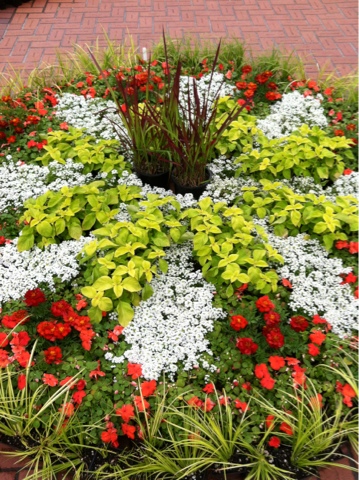
Festival of flowers

As a Portlander, I am not much of a Rose Festival fan. But, one aspect of the festival that I am totally behind is the Festival of Flowers (FoF).

Basically the FoF consists of temporary installations of potted plants. The largest arrangement is in Portland's living room, or Pioneer Courthouse Square, but if you look around over the next 2 weeks you will find them in other spots around downtown.

Beautiful!

Friday, May 25, 2012

Ultimate springtime meal

We are off to the coast for the weekend. We arrived to bright sun and are enjoying my father-in-law Tony's "world famous" negronis while shucking our first batch of favas from the garden.

Mark parboiled the favas and lightly mushed them up with lemon juice, olive oil, Parmesan, salt,pepper and a sprinkling of thyme. Spread on a piece of lightly toasted bread, these spring gems were a great start to our meal!

Also on the docket were new potatoes that were slow butter poached with leeks from our garden and time, er thyme and spring salmon slow roasted at 225 until moist, tender and delish with lemon butter dill sauce.

All followed by a fabulous strawberry rhubarb pie from pieku - yum!

Thursday, May 24, 2012

Not everyone will make the team

I visited Seattle, WA a couple of weekends ago, and while I was there, my cousin's son Andrew had three consecutive try outs for a kid's community-based soccer team.

It got me thinking. Do I put the plants that make up my garden's team through such a rigorous set of tryouts?

It seems that the answer is - sort of.


We are now in our third year with our back yard, and our second in the front. While the original plans of both were mostly painstakingly planned out, they are also definitely punctuated with a spontaneously purchased plant here and there.


In addition, it turns out that our initial plans included mostly deciduous shrubs and perennials which were specifically selected for seasonal attributes - early or late blooms, exceptional fall foliage, etc.  Then winter came and the garden faded into a shadow if itself. To address this, I added vignettes of "winter interest" plants throughout the garden.

Sounds good, right? Right.

Except that I didn't remove any of the original plantings, and now it is colossally overcrowded and something must be done.

In other words, it is time to cut some members of the team.

Reason 1 for not making the cut: It's not you, it's me.
Call me fickle or, perhaps, discerning? But, some of the plants I loved for the garden a year or two ago just don't turn me on like they once did. They haven't changed, but my tastes have.Time to send them packing.

Reason 2 for not making the cut: You played a good game, it's just someone played it better.
One good thing about over planting is that you are bound to actually place some plants in conditions that they naturally will thrive in. Once a plant really starts to thrive, watch out! Everything else around it starts to pale in comparison.

In this case, it is time to find the under achievers a new home. Preferably elsewhere in your or someone else's garden, but if need be in the compost. (That last option is my least favorite.)

Reason 3 for not making the cut: Fine doesn't cut it.
We have a standard city plot of 50 by 100 feet. As a result, each plant in our garden must bring something exceptional to the game in order to be on our team. Fortunately, I find things about many plants exceptional. Some are subtle, while others are more in your face about it.

But, if I really think about it, there are several plants in our garden that are just "fine." Not bad, but certainly not exceptional. Time to cut some bench warmers.

Reason 4 for not making the cut: There is no "I" in team.
As it turns out, there are also some plants in our garden that are doing too well. You know the type, overly pushy, singularly focused on themselves, no room for anyone else? The "enough about me, what do you think about me" types? Yep. They've got to go too.


Speaking of no "I" in team, these Oriental poppies are overtaking my Chinese fringe flower shrub. Though these guys are literally perennial volunteers, they are in a spot I want something else to grow so they need to go!


Tuesday, May 8, 2012

Scenes of spring in the garden

It is hard to believe that most of the spring bulbs have wrapped up their vernal performance.

But, the garden is still in full swing with loads of new blossoms and lush foliage taking center stage.

Here are a few of my favorites of the moment.

Friday, March 30, 2012

You say tomato, she says toe-mah-toe - I say yum!

I don't know about you, but I have summer on my mind.

Perhaps it is the blustery and rain spattered weather today that is making me long for warmer days and hours in the garden.

Or, perhaps it is the thought of being able to finally eat a tasty and tangy tomato which I am reminded of each time I see one of those anemic, cardboard imposters in the stores now.

Whatever it is, I am sitting here this Friday afternoon with my 2012 garden plan and tomato seed packets dreaming of summer.
This year, I am growing 11 varieties of tomatoes here in our garden - some cherry, some for canning and some for slicing. Some will be repeats from last year, and some will be new to me.

Last year...
Incredibly we managed to have a pretty banner year last summer despite the less than ideal growing growing conditions. My favorites were the Japanese Trifele and the Orange Pixie since were incredibly productive and tasty!  I had little luck with the san marzanos, though that could easily be because I had to wait to put them in until the peas were done in mid July.

Lesson learned - make sure that whatever is planted in the spring has a short growth period so that there is no chance that the tomatoes won't be put in the ground by mid June at the very latest!

The last of summer 2011's haul.
Starts for sale...
I am planning to grow and sell tomato starts again this year - four-inch pots for $2.50 each. They will be ready for pick up by mid to late May, depending on the weather.  I am taking orders right now, and will have some additional starts on-hand on a first come, first served basis.

Cherry Tomatoes
  • NEW! Chocolate cherry: Plants are super productive and produce one inch chestnut and port-wine colored fruit with a delicious, multifaceted flavor. (Indeterminate, 70 days)

  • Gold nugget: Gold Nugget plants are loaded with 1 inch, round golden fruit from early in the season 'til frost. Fruits are unusually rich and sweet flavored when ripe. (Determinate, 60 days)
  • Orange pixie: This plant’s strong, short vines make it the perfect tomato for containers and window boxes. Yellow- orange fruit is just over an inch in diameter and has excellent flavor. (Determinate, 52 days)
  • Sun gold: The unique flavor of this tomato gives it an almost "cult" following. The plants will be loaded with clusters of eight to fourteen tomatoes about an inch in diameter throughout the summer until frost. May be grown in containers with support. (Indeterminate, 57 days)
Sauce/Paste Tomatoes
  • San marzano: This classic Italian paste tomato is considered by many to be the world's best! A low sugar, low-acid tomato, it has a high solids content and excellent flavor. The oblong red fruits are 3"-4" long and 1.5" wide. (Indeterminate, 80 days)
Slicing Tomatoes
  • Brandywine: Amish heirloom with famous distinct flavor, grown since 1885. Fruits are 10 to 14 oz., dark reddish pink, tender and juicy. (Indeterminate, heirloom potato-leafed plants, 85 days)
  • NEW! Burbank slicing: Developed by Luther Burbank around 1915. Determinate and fairly early, Burbank Slicing is a heavy yielder of majestic 3-4 inch fruit. The fruit has a very deep red color and a traditional bold tomato flavor. This was the only variety that Mr. Burbank raised for canning. (Determinate, 75 days)
  • Pineapple: Large, irregular yellow fruits are suffused with red streaks that radiate from a red interior. The flavor is rich and fruity. (Indeterminate, heirloom, 95 days)
  • NEW! Gold medal: This whopper is unbelievably early for its size. The large yellow fruit have an interior blush of red and weigh over 1 pound, some reaching 2 pounds.  The plants grow well in cool nighttime temperatures. (75 days, Indeterminate)
  • Japanese Black Trifele: Pear-shaped fruit has green-streaked shoulders, deepening to a burnished mahogany and finally to a darkened, nearly black base. The meaty interior has similar, opulent shades and an incomparable, almost indescribably complex and rich flavor to match. The fruit reach 2 1/2-3 inches long and wide and are very crack-resistant. Despite the name, this thoroughbred has its origins in Russia. (Indeterminate, heirloom potato-leafed plants, 80-85 days)
  • Green Zebra: This unique tomato is very flavorful and sweet, yet has a zingy and well-balanced taste that isn't too acidic. Mature fruits are golden green with forest green stripes and reach 3 inches in diameter.
About the above descriptions: I have culled these descriptions and images from their seed packets and catalogs – ask if you have additional questions.

Saturday, October 1, 2011

Dilled Carrots

Last Sunday  we started our second part of our pickle mania marathon. Operation dilled carrots and pickled beets.

The carrots are such a treat during the winter months since they have a light brine and the sweetness of carrots.

Luckily I forgot the sheer amount of work involved in peeling and chopping the carrots from last year.

 
It took just over two hours to peel and chop the 25 pounds into sticks to fit into the jars.

There were several pounds of "dividend" carrots that were too small to cut into sticks that I cut into medallions.

With the majority of the sticks we created dilled carrots with garlic, fresh dill and brine from a recipe from the Ball Home Preserving Book.

A quick note on the brine - when we made the brine we initally found that the amount of salt that the recipe called for was WAY too over powering and so used half of the salt called for and a tiny bit of sugar to soften it.

Once we had the taste of the brine squared away it was pickling time!

This recipe is cold packed meaning that you put the spices and the carrots into the jars and then add the brine. The trick with carrots (and many other vegetables is to get enough of them into the jars so that they don't float willy-nilly in the jar - once packed firm they tend to stay put better.

Mark also tried a two recipe variations with some of the sticks that we hope will be interesting. Stay tuned...here is the gist:
  1. Chinese inspired with ginger, star anise and Chinese chiles.
  2. Carribean with ginger, garlic, bay, habanero, all spice and yellow mustard seed.
All told we ended up with about 30 pint jars of pickled carrots.

While processing and pickling the carrots we roasted the beets for 2 hours and then late in the day set about peeling them. We ended up getting half way through before deciding that they would have to wait on another day.

More on that in another post...